Mini Split Installation in Ashland, VA
A new system here will heat from October through April and cool from June through September every year. Tell us about the house, and a licensed contractor who covers Hanover County will get in touch.
Tell us about the job
It takes about a minute.
What a mini-split in Ashland has to handle
Ashland asks a mini-split to work most of the year. Heat runs October through April, seven months, and winter nights average 28°F. Cooling picks up June through September with afternoons averaging 87°F. That leaves one real month of rest.
A new unit manufactured now has to meet 14.3 SEER2 for cooling and 7.5 HSPF2 for heating, the federal minimum for this kind of system. Sizing it to actually hold 28°F nights and 87°F afternoons matters more here than the rating on the label.
- 7 months
- October through April, your system heats
- 4 months
- June through September, it cools
- 28°F
- the average winter night it heats against
- 87°F
- the average summer afternoon it cools against
NOAA nClimDiv, 1991–2020 normals
Virginia requires HVAC contractors to hold a state license.
Virginia's Board for Contractors tests and records the contractor, not the job. The license belongs to the business and covers whatever work that business takes on, not any single install. Work under $1,000 does not need a licensed contractor at all, but a mini-split installation runs well past that line, so this is a job the state expects a licensed contractor to hold.
The license covers who is allowed to take on the work. It does not replace the permit. In most cities and counties, installing a mini-split needs a permit from the local building office, and the finished work gets an inspection before it is signed off. That inspection is what checks the parts of the job the license alone does not reach, the mounting, the wiring, the line set, the drainage.
Sources: Virginia General Assembly · Virginia Department of Professional and Occupational Regulation
- Is a mini split worth it?
- For most homes here, yes, because a mini split handles both jobs, heat from October through April and cooling from June through September. That's 11 months a year leaning on one system. It also gives you a heat source that isn't tied to your ducts, which is worth something given how many winter storms and wind events this area sees. A contractor can look at your specific rooms and tell you what size and how many heads make sense.
- How many rooms can a mini split cover?
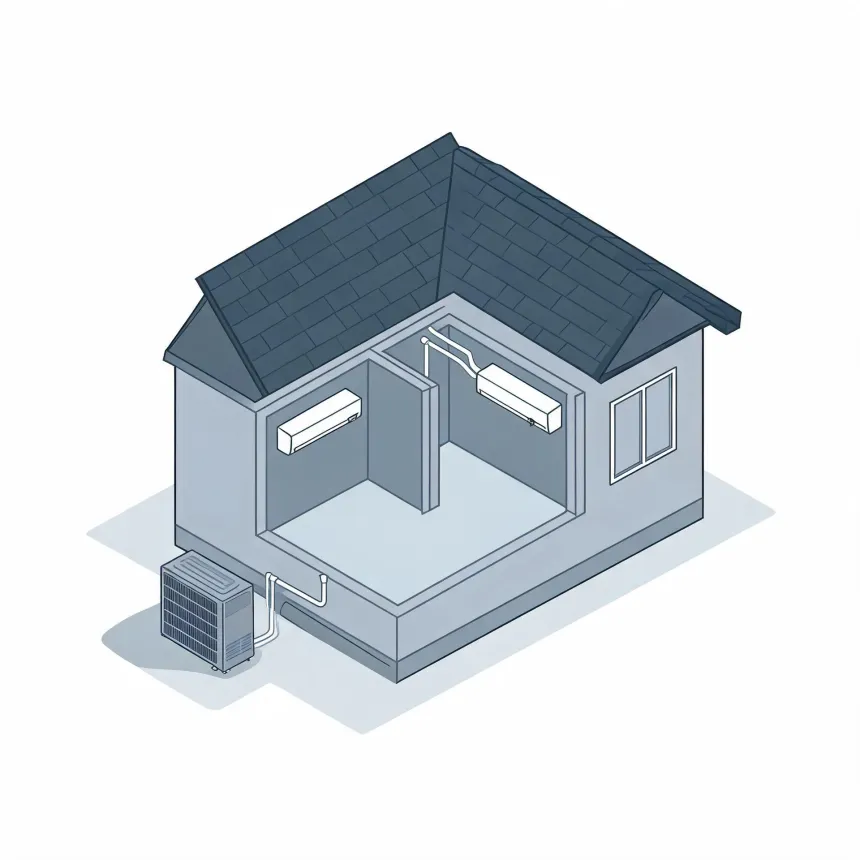
- A single outdoor unit can run more than one indoor head, so it can cover several rooms at once. Each head is sized to the room it serves, so a contractor measures the space, the windows and the walls before deciding how many heads you need and where they go. Put too many rooms on one outdoor unit and every head runs weaker, so this is worth sizing right rather than guessing.
- Can a mini split heat a whole house?
- It can, with enough indoor heads placed in enough rooms and an outdoor unit sized for the whole house. On a 28°F winter night, a heat pump has to work harder to keep up, so the system has to be sized for that, not just for a mild afternoon. A contractor can calculate the heat loss for your house and tell you whether a whole-house mini split setup will keep every room warm through the coldest nights, or whether some rooms need a different approach.