Does closing vents help your AC in Virginia

Tune-up, service, or cleaningCentral ACVirginia
Step 1 of 2

What ZIP code is the job in?

Closing vents in unused rooms does not help your AC, and in most homes it works against it. Your system is sized to move a set amount of air through the whole duct run. Shut several vents and that air has nowhere to go, so pressure builds in the ducts. The blower works harder, the coil can ice up, and air starts leaking out through small gaps in the ductwork instead of reaching the rooms you actually use. With Virginia summers running hot and sticky for months, that extra strain shows up fast, either as a warm house or a system that struggles to keep up. If a room runs warmer than the rest, closing its vent is not the fix. Better airflow, a blocked duct, or a return that is too small for the space are the things worth having a contractor look at.

A woman in a cream sweater with her hair in a bun laughs while seated at a stone counter holding a glass of red wine, in a dimly lit interior with a sofa, houseplants and a large window at night.
A woman with long dark hair in a cream knit sweater laughs while looking off to the side, seated in front of a dimly lit kitchen with an island, stools, open shelving and a potted plant, with a glass of red wine in the foreground.
A smiling woman with long dark wavy hair in a light knit sweater sits at a marble counter with a glass of red wine, with a dimly lit living room and kitchen in the background.
A smiling woman with long wavy brown hair in a beige sweater sits at a white marble counter with a glass of red wine, with a living room, dining table and kitchen cabinets behind her.
A closed silver laptop and a glazed ceramic mug on a wooden table, with a blurred kitchen counter, potted plant, cutting board and window in the background.

What closed vents cost you at home

Shut the vents in a spare bedroom or a basement you don't use, and the first thing you'll likely notice is the system running longer to cool the rooms you do use. The air has to go somewhere, so it pushes out through gaps in the ductwork instead of the room it was built to reach. In a Virginia summer, with the compressor already working hard against the humidity, that extra strain adds up. Some homeowners end up with a room that never gets comfortable no matter how long the system runs, while the electric bill climbs for no real gain.

Checking whether your duct system is actually balanced for the way you use your house isn't something you can tell by standing at a vent. It takes someone who services this kind of system all season and knows what a duct run is supposed to look like versus what's straining it. Finding that person usually means searching around, calling a few companies, and repeating the same description of your house to each one before you can even compare what they'd charge. A local contractor who already knows the equipment common in Virginia homes can look at your setup directly instead of you doing that legwork first.

Interior corner of a dining room with a round wooden table, a ceramic vase holding olive branches, a dark spindle-back chair near a curtained window, and a sideboard with a lamp against beige walls.
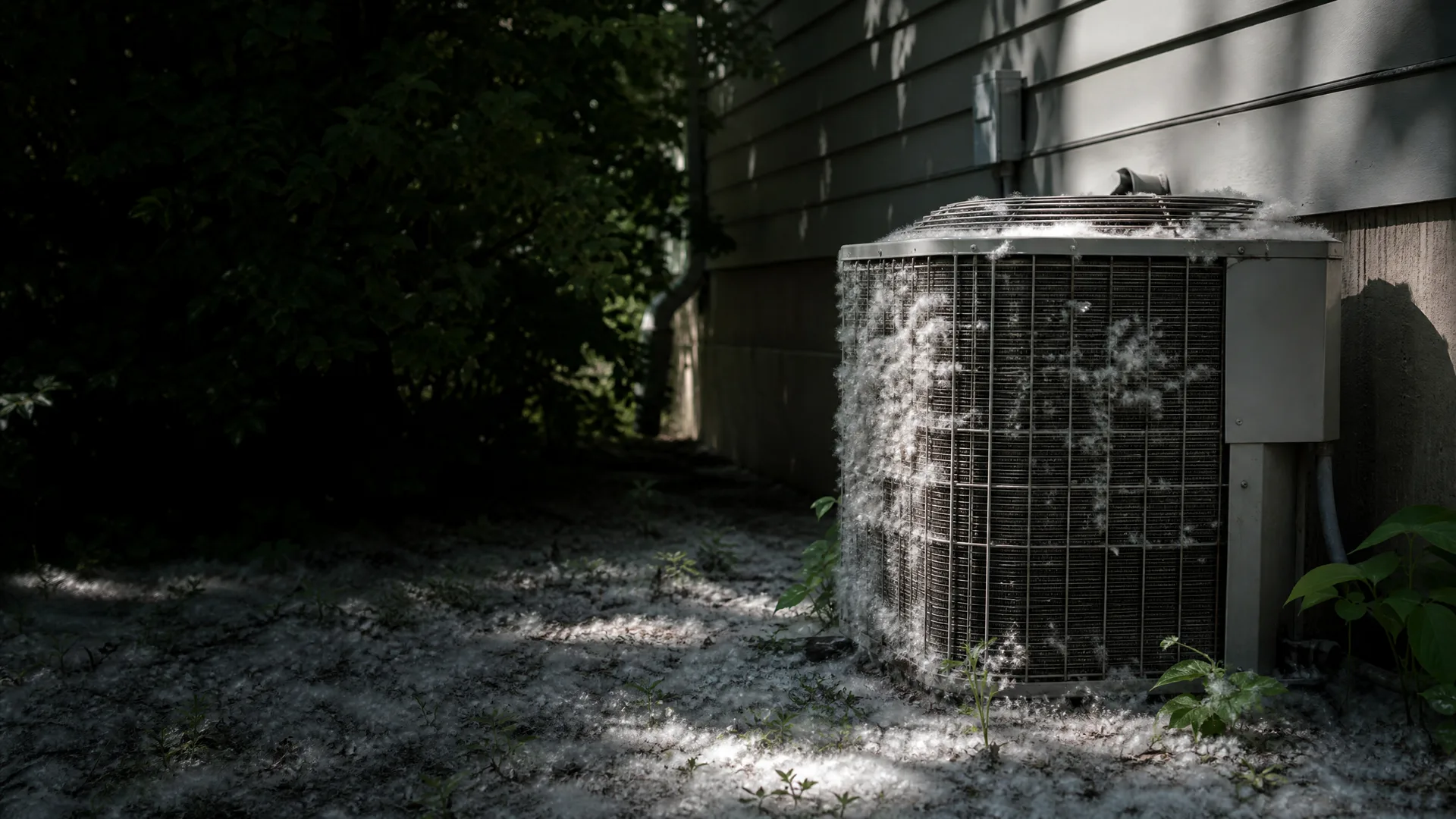
An outdoor air conditioner condenser unit beside a house with horizontal siding, its coil covered in white cottonwood fluff that also blankets the ground around it.

You're out pulling weeds along the side yard in late May, the kind of warm that tells you summer's close. You stop by the condenser to move a hose out of the way and notice the fins are packed white, cottonwood fluff from the trees down the street, caught in the coil like snow that won't melt. You run a finger across it and it barely budges. The unit's still running, you can hear it, but the air coming off the top feels weaker than it should for how hard the compressor is working. You make a note to clear it before the heat really sets in, then go back to the weeds.


Power costs 15.28 cents per kilowatt-hour statewide

At 15.28 cents per kilowatt-hour, every extra hour your AC runs chasing air through closed vents shows up on the bill. Leave the vents open and the system covers the house the way it was set up to, instead of working harder and longer for the same cool air.

EIA-861 2025 statewide residential average

A gray outdoor air conditioning condenser unit on a concrete pad beside a house with horizontal siding and a stone veneer base, with a wall-mounted disconnect box and conduit, next to a shrub bed and a concrete patio.

Vents open, system balanced

This is what a system working the way it was designed looks like. Air moves out through every vent and back in through the return, and the pressure in the ducts stays where it should. The condenser outside cycles on, does its job, and shuts off.

An outdoor air conditioner condenser unit on a concrete pad beside a house with light gray vinyl siding, with a gray electrical disconnect box and conduit on the wall, gravel beds and dried plants nearby, and a concrete sidewalk in the foreground.

Vents closed, system straining

Weeds at the base, a weathered cabinet, a unit left to work harder than it should for longer than it should. Closed vents upstream push the strain out here, onto the compressor and the coil, cycle after cycle, all summer.

A bearded man in a dark navy sweater over a collared shirt smiles and looks off to the side while seated at a dinner table with a glass of red wine, a lit candle, and a plate of food in the foreground of a dimly lit room.
A woman in a dark gray sweater reclines on a couch with her eyes closed and a knit blanket over her lap, an open book resting face-down in front of her, with a lit table lamp and shelving blurred in the background.

Skip the search

A duct system that's been fighting closed vents all summer usually isn't the only thing off. Pressure that has nowhere to go finds the weak seam in a duct joint, or it leaves a coil running longer than it should, and by August you've got a system that's working harder than the day it was installed. Someone who services AC units around Virginia every summer knows what that strain tends to turn into, because they've opened up enough of these systems mid-season to recognize it on sight. Finding that person yourself means calling around, describing the same problem three or four times, and weighing quotes that don't quite match up. Handing it off instead means one local contractor, licensed for this work, gets your request and looks at your system specifically, not a general description of what closed vents do. If your ducts have been under that kind of pressure, it's worth having someone check before the season gets any hotter.

Leave the vents open

  • Leave every vent open and let the system move air the way it was set up to from the start.
  • A duct system under pressure all summer tends to find the weak seam first, long before the compressor gives out.
  • A contractor who services AC systems in Virginia all summer knows the duct and pressure problems closed vents tend to cause here.
  • You're matched with one local, licensed contractor instead of fielding calls from several companies trying to win the job.
  • Checking vents takes a minute; what matters more is having someone who knows this equipment look at the rest of the system before summer heat pushes it harder.

Closed vents don't save you anything. The system still moves the same amount of air whether a room gets it or not, so blocking a few vents just pushes that air somewhere it wasn't meant to go. Open them back up and the system runs the way it was set up to, covering the house evenly instead of straining to cool the rooms you left open.

That strain doesn't sit still. Pressure with nowhere to go works on whatever in the duct run is weakest, a loose joint or a seam that was never airtight to begin with, and it does that quietly for months before you notice anything through the vents themselves. By the time a room runs warm or the system won't shut off, the closed vents are usually the smallest part of what's wrong.

This is where it helps to have someone who knows what a Virginia summer does to a duct system that's been fighting itself since May. A local contractor who works on this equipment all season has likely already seen what pressure like that does to a seam or a coil, and knows where to check first. You're matched with one licensed contractor for the job, not a handful of companies calling to bid on it. Open the vents today if you haven't already. Then get someone out to look at the rest of the system before the heat pushes it any harder than it already has been.

A covered porch with a wood front door with six upper glass panes, a lantern wall sconce, tapered column on a stone base, potted ferns and flowers, a woven doormat, and wide steps leading to a paver walkway bordered by shrubs and white hydrangeas.
A beige upholstered sofa with a cream cushion and chunky knit throw sits beside a white-framed window, with a leafy potted plant in a stone vase against a tan wall.
Sunlit corner of a room with a linen curtain beside a window, built-in shelves holding ceramic vases, wooden bowls, a potted green plant, stacked books and a woven basket, above a textured rug.
A dark wood three-drawer dresser against a pale wall holds a tall ceramic vase with leafy branches, stacked books and a shallow bowl, with a framed print above, a woven basket on the wood floor at left, and an upholstered sofa with a green pillow in the foreground.
A cream upholstered sofa with a textured ivory cushion and a rust-colored cushion sits beside a window with sheer linen curtains, with a potted leafy plant behind it and a wooden bowl on a wood table in the foreground.

Explain it one time

Only one pro gets your request, so you hear from one company.

Describe it once

No fee to send it, and nothing to sign.