
Mini Split Installation in Herndon, VA
A new system here will heat from October through April and cool from June through September every year. Tell us about the house, and a licensed contractor who covers Fairfax County will get in touch.
Tell us about the job
It takes about a minute.
Herndon asks a mini-split to run almost all year
Heat or cooling runs 11 months here, heat from October through April and cooling from June through September. That is most of the year working, not a few weeks in summer and a few in winter.
Winter nights average 28°F, which is cold enough that a heat pump has to keep pulling heat out of outside air on a regular basis all season. Summer afternoons average 86°F on the other side. A mini-split installed here has to hold up through both. Any unit made from 2023 on has to meet 14.3 SEER2 for cooling and 7.5 HSPF2 for heating, since the split-system minimum covers ductless units too. That is the floor, not a special ductless rule.
- 7 months
- October through April, your system heats
- 4 months
- June through September, it cools
- 28°F
- the average winter night it heats against
- 86°F
- the average summer afternoon it cools against
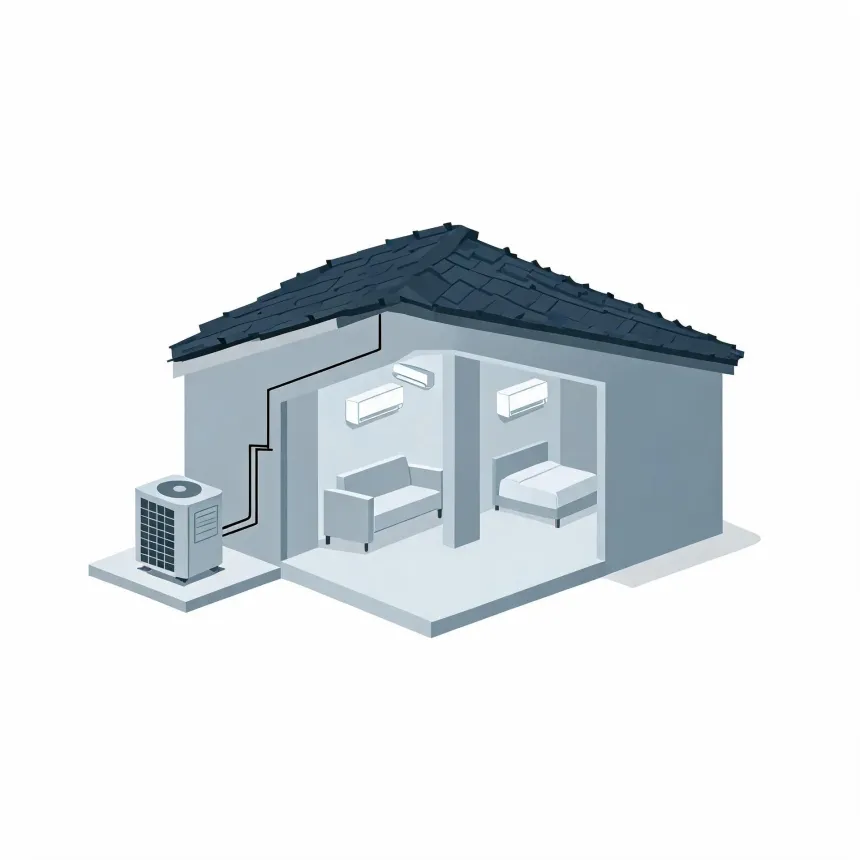
NOAA nClimDiv, 1991–2020 normals
Virginia requires HVAC contractors to hold a state license.
The Board for Contractors licenses the contractor as a business, not the specific job. The same license covers this installation and whatever other HVAC work that contractor does elsewhere in the state. Virginia sets one exception. Work under $1,000 does not need a licensed contractor. A mini-split installation runs well past that amount, so the license requirement applies here.
That license tells you the contractor was tested and is on record with the state. It does not cover what happens after the mini-split is installed. In most cities and counties, this kind of installation needs a permit from the local building office, and an inspection once the work is done. That inspection checks the installation itself, separate from whatever the license already tells you about the contractor.
Sources: Virginia General Assembly · Virginia Department of Professional and Occupational Regulation
- Is a mini split worth it?
- For most homes it is, especially if you're heating or cooling a room or addition that ductwork never reached. You get heat and air conditioning from one system, and units built since January 2023 have to meet efficiency minimums of 14.3 SEER2 and 7.5 HSPF2, so you're not choosing between an old inefficient unit and a new one. With winter lows around 28°F here, look for a mini split rated for cold climates so it keeps up on the coldest nights. A contractor can tell you whether it fits your house better than a furnace or heat pump replacement would.
- How many rooms can a mini split cover?
- A single indoor head is built to heat and cool one room or one open area. If you need more rooms covered, a multi-zone system runs several indoor heads off one outdoor unit. Each zone gets its own thermostat, so you can heat a bedroom overnight without running the whole house. A contractor sizes the outdoor unit and the number of zones to the square footage and layout of your home.
- Can a mini split heat a whole house?
- Yes, if it's sized and placed for that. A multi-zone system with enough indoor heads can heat every room, and a cold-climate model will keep working through winter nights here that average 28°F. Homes here need heat from October through April, so the system has to be sized for that full stretch, not just a mild day in fall. A contractor can size the system to your home and tell you how many zones it takes to cover it.