Mini Split Installation in Arlington, VA
A new system here will heat from October through April and cool from June through September every year. Tell us about the house, and a licensed contractor who covers Arlington County will get in touch.
Tell us about the job
It takes about a minute.
Arlington asks a mini-split to work almost year round
Heat runs October through April here, then cooling picks up in June and holds through September. That is 11 months where the system is doing something. Winter nights average 29°F, cold enough that a mini-split needs to hold its heating output, not just its cooling output, to keep a room comfortable. Summer afternoons average 86°F, a steady load that runs for four straight months.
Any mini-split installed new has to meet the federal minimum for split-system heat pumps, 14.3 SEER2 for cooling and 7.5 HSPF2 for heating. That floor applies whether it is a single indoor head or a multi-zone system. With seven months of heating against four of cooling, the heating side of that rating matters as much as the cooling side.
- 7 months
- October through April, your system heats
- 4 months
- June through September, it cools
- 29°F
- the average winter night it heats against
- 86°F
- the average summer afternoon it cools against
NOAA nClimDiv, 1991–2020 normals
Virginia requires HVAC contractors to hold a state license.
The license belongs to the contractor, not to any one job, so the state has already tested and recorded whoever you hire before they show up at your door. Virginia does carve out an exception for small jobs. Work under $1,000 does not need a licensed contractor, but a mini-split installation runs well past that, so this is licensed territory.
Because Virginia licenses the contractor, that license is the thing accountable for this installation. Most cities and counties also require a permit from the local building office for this kind of installation, with an inspection once the work is done.
Sources: Virginia General Assembly · Virginia Department of Professional and Occupational Regulation
- Is a mini split worth it?
- For a lot of homes here, yes, especially a room or addition that never gets heated or cooled the way the rest of the house does. Arlington sees winter lows around 29°F and summer highs around 86°F, and a mini split can hold a room at temperature through both without any ductwork. Over half the homes here already heat with electricity, so running one isn't a strange fit for the area. Whether it makes sense for your house depends on the room, the layout, and what you're trying to fix, and a contractor can walk through that with you.
- How many rooms can a mini split cover?
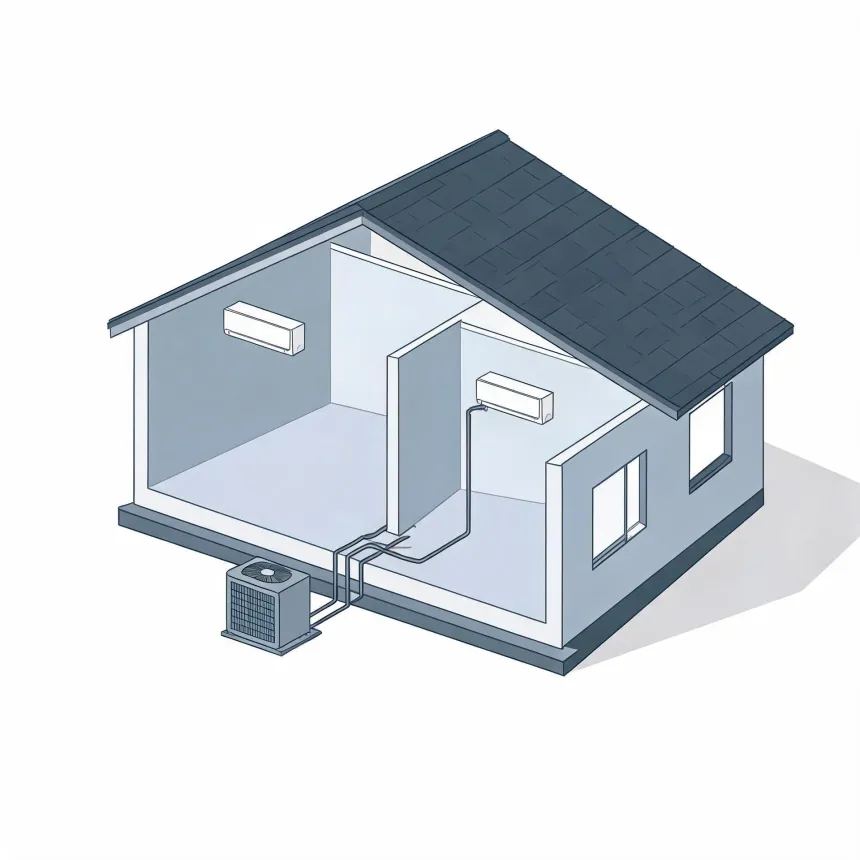
- A single outdoor unit can run one indoor head or several, depending on the system. Single-zone systems cover one room or open area. Multi-zone systems run several indoor heads off one outdoor unit, each one controlled on its own. The number that makes sense for your house depends on how the rooms are laid out and how much heating and cooling each one needs, which is something a contractor sizes room by room.
- Can a mini split heat a whole house?
- It can, if enough indoor units are installed to reach every room. Arlington needs heat from October through April, seven months of the year, so any system meant to carry the whole house through that stretch has to be sized for it from the start. That means accounting for every room, not just the ones that run cold. A contractor can look at the house and say whether a full mini-split system covers it or whether it works better alongside existing heat.