Mini Split Installation in Newport News, VA
A new system here will heat from November through April and cool from May through September every year. Tell us about the house, and a licensed contractor who covers Newport News will get in touch.
Tell us about the job
It takes about a minute.
Newport News asks for eleven months of run time
Your mini-split works most of the year here. Winter nights average 33°F from December through February, and summer afternoons average 87°F, so the system is heating or cooling eleven months out of the year. That is a lot of hours on the compressor and a lot of cycles on and off.
Any unit installed new has to clear the federal minimum for a split-system heat pump, 14.3 SEER2 for cooling and 7.5 HSPF2 for heating. That is the floor, not a feature, so it is worth confirming what you are getting actually meets it. Storms are also part of living here. Virginia saw 22% of households lose power for at least 24 hours in 2024, and the region has logged 31 damaging wind events and 6 winter storms over the past ten years, so an outage during a cold snap or a hot stretch is worth planning around.
- 6 months
- November through April, your system heats
- 5 months
- May through September, it cools
- 33°F
- the average winter night it heats against
- 87°F
- the average summer afternoon it cools against
NOAA nClimDiv, 1991–2020 normals
Virginia requires HVAC contractors to hold a state license.
Virginia licenses HVAC contractors through the Board for Contractors. The license covers the contractor, not each job, so the same license that lets someone install a furnace also lets them install a mini-split. The state does carve out one exception. Work under $1,000 does not need a licensed contractor, but a mini-split installation runs well past that line, so the contractor doing this job should hold the state license.
That license means the state tested this contractor and keeps a record of them. It does not end the paperwork on this job. Most cities and counties in Virginia also require a permit for this kind of installation, along with an inspection once the work is done, and that step comes from the local building office rather than the state.
Sources: Virginia General Assembly · Virginia Department of Professional and Occupational Regulation
- Is a mini split worth it?
- For the right house, yes. A mini split heats and cools without ducts, so it works well in additions, garages, or older homes where running ductwork would mean tearing into walls. Newport News homes need heat or cooling 11 months of the year, so a system that handles both jobs earns its place. Units installed now have to meet 14.3 SEER2 for cooling and 7.5 HSPF2 for heating, so efficiency is not something you have to shop for separately.
- How many rooms can a mini split cover?
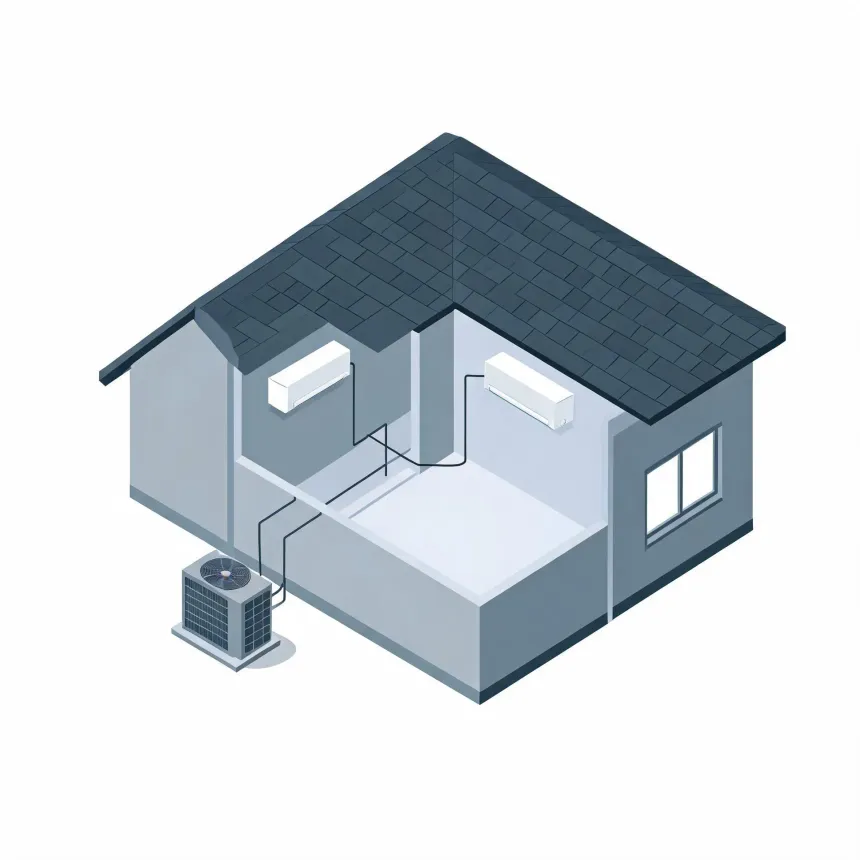
- A single outdoor unit can run one indoor head or several, depending on the system. Single-zone systems cover one room or open area. Multi-zone systems tie one outdoor unit to multiple indoor heads, each running on its own thermostat so you can heat or cool one room without the others. How many zones a given outdoor unit supports is a limit set by that model, so a contractor will size it to the rooms you actually want covered.
- Can a mini split heat a whole house?
- It can, if enough indoor heads are placed to reach every room. A single indoor unit heats the space it sits in and whatever is open to it, not rooms down a hallway or behind a closed door. Winter nights here average 33°F, so the system also has to be sized for that low, not just for mild days. A contractor will look at the layout and figure out how many zones the house needs to stay warm room by room.