
Mini Split Installation in Virginia Beach, VA
A new system here will heat from November through April and cool from May through September every year. Tell us about the house, and a licensed contractor who covers Virginia Beach will get in touch.
Tell us about the job
It takes about a minute.

Eleven months of the year, your mini-split is working
Virginia Beach only gives a mini-split a few weeks off. Heat runs November through April, with winter nights averaging 35°F. Cooling picks up May through September, with afternoons around 85°F. That is eleven months a year the system is doing one job or the other, and a new unit needs to be sized for both sides of that, not just the summer heat.
If the unit was manufactured after January 1, 2023, it has to meet 14.3 SEER2 for cooling and 7.5 HSPF2 for heating. That is the federal minimum for split-system heat pumps, and a ductless mini-split falls under that same rule. Most homes here heat with electricity, and this area has seen its share of damaging wind over the past ten years. A storm that takes down power takes down the heat with it, so it is worth asking what backup the system has.
- 6 months
- November through April, your system heats
- 5 months
- May through September, it cools
- 35°F
- the average winter night it heats against
- 85°F
- the average summer afternoon it cools against
NOAA nClimDiv, 1991–2020 normals
Virginia requires HVAC contractors to hold a state license.
The license is tied to the contractor's business, not to each job. The same license covers a furnace install last week and your mini-split this week. Virginia does carve out an exception for small jobs. Work under $1,000 does not need a licensed contractor at all. A mini-split installation runs well past that, so this job falls under the licensing rule.
Most cities and counties also require a permit from the local building office for this kind of installation. An inspection follows once the work is done. That inspection checks that the mini-split was put in correctly. The license itself only tells you the contractor was tested and is on record with the state.
Sources: Virginia General Assembly · Virginia Department of Professional and Occupational Regulation
- Is a mini split worth it?
- For the right room or house, yes. A mini split heats and cools without ducts, so you are not losing energy to duct leaks, and each zone has its own thermostat so you only condition the rooms you use. Homes here need heat November through April and cooling May through September, so a unit doing both jobs stays busy nearly all year. A contractor can look at your house and tell you whether it fits your situation better than central air or a furnace replacement would.
- How many rooms can a mini split cover?
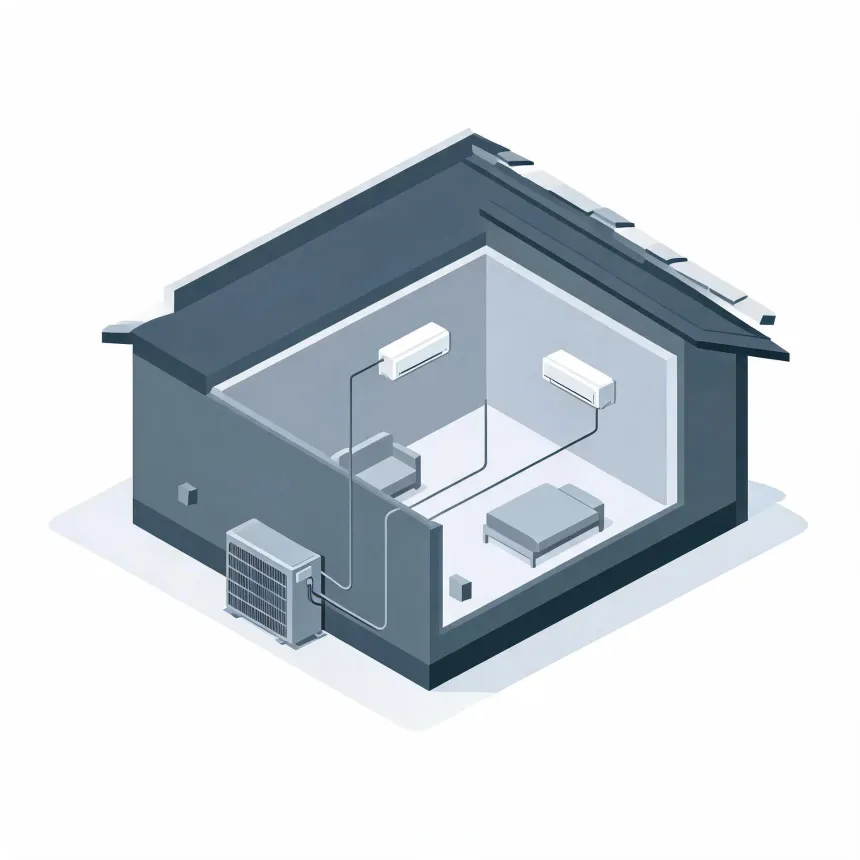
- A single outdoor unit can run one indoor head or several, depending on the system. Single-zone systems cover one room or one open area. Multi-zone systems split the output across several indoor heads, each with its own thermostat, so you can cover multiple rooms or a whole floor from one outdoor unit. How many zones make sense for your house depends on the layout and how the rooms are used, which is something a contractor sizes room by room.
- Can a mini split heat a whole house?
- It can, if enough zones are placed to reach every room. A mini split works as a heat pump, pulling in heat from outside air even in cold weather, so it does not need a furnace behind it. Winter nights here average 35°F, and a heat pump sized and placed correctly still puts out heat at that temperature. Whether one outdoor unit or more than one is needed for a whole house depends on the square footage and floor plan, which a contractor can work out from a visit.