
Clean it yourself
You can wipe down the registers and grille covers, but the supply plenum and the runs behind your walls are out of reach without the right tools.
Skip searching for someone who cleans ducts in Fairfax County.
Fill out one formMold in air ducts usually shows up as a musty smell when the system kicks on, sometimes with dark speckling around the vent covers or the return grille. Humid summers in the Herndon area give it what it needs. Moisture gets into the ductwork from a condensate line that drains slowly, a return that's sweating, or just the muggy outside air moving through a system that cycles on and off all summer. Once mold has a foothold on the dust and debris inside the ducts, it keeps feeding on whatever passes through, and running the system spreads spores into the rooms instead of clearing them out. If people in the house are coughing more, or the smell is stronger in some rooms than others, that points to where the growth is worst. Cleaning the ducts removes the mold and what it was growing on, but anything still letting moisture in in the first place needs fixing too, or it comes back.
Half the homes here were built by 1983
Half the homes in Fairfax County date to 1983 or earlier, and older duct runs and seals give moisture more places to collect and hide.
Heat runs October through April
Ducts push humid air through your house for seven months, October through April, giving mold a long stretch of warm, damp conditions.
Cooling runs June through September
Cooling runs June through September, and the condensation that forms around the AC coil during those months is what feeds mold between cleanings.
ACS 2020-2024 · NOAA nClimDiv 1991-2020
Mold doesn't start in the duct itself. It starts at the evaporator coil, the part inside your air handler that pulls humidity out of the air every time the AC runs. That water is supposed to drip into a drain pan and out through a condensate line. When the pan cracks, rusts through, or the line clogs, water sits where it shouldn't, and the coil area turns into a breeding ground. From there it's a short trip. The blower pushes air across that coil and into the supply plenum dozens of times a day, all summer, and any spores riding that air get carried into the duct runs and out to your vents. Dust already living in the ductwork gives mold something to feed on once it arrives, so a duct that's gone a few years without cleaning has exactly what mold needs sitting inside it.
Return ducts add a second way in. If yours runs through a crawlspace or attic that isn't conditioned, the metal or flex duct itself can pick up moisture from the air around it, even if nothing inside your house is wet. That's why a contractor who knows this checks the coil and drain pan first, since that's where most problems start, then looks at the duct interior itself. Insulation and liner inside the ductwork make this harder to catch early, because mold can take hold inside that material where a visual check or a quick wipe-down won't find it.




You can wipe down the registers and grille covers, but the supply plenum and the runs behind your walls are out of reach without the right tools.
A contractor who works on duct systems in Fairfax County every summer comes out, checks the coil and drain pan, and tells you what's actually growing and where.
You can picture mold sitting at one vent, but what you're smelling is usually coming from more than one spot. Once it takes hold near the coil or in a damp section of duct, the system itself becomes the thing that moves it. Every time the blower runs, it pushes air past that spot and on through the rest of the house.
Mold releases spores into the airstream, and the blower motor is what pushes that air through every supply run in the house. A patch that starts near the evaporator coil doesn't stay there. Air moves from the plenum into the branch ducts and out through each register, carrying spores with it into every room the system serves. That's why you can smell it in a bedroom far from the furnace closet. The return side works the same way in reverse, pulling air and whatever is riding in it back toward the coil. Running the system more, trying to air it out, moves more spores around rather than fewer. The growth itself stays put. It's the air passing over it that spreads what it's producing.
A contractor inspects the coil, drain pan, and duct runs with a camera.
Negative air pressure gets set up so loosened spores stay out of your house.
A rotary brush or whip knocks mold and dust loose inside the ducts.
High-powered vacuum pulls the loosened debris out through the access points.
At 15.03 cents per kilowatt-hour, running the blower longer to fight a musty smell or push air through a clogged return adds up on your bill. A duct system clear of mold moves air the way it was designed to, so the system isn't working harder than it has to.
EIA-861 2025

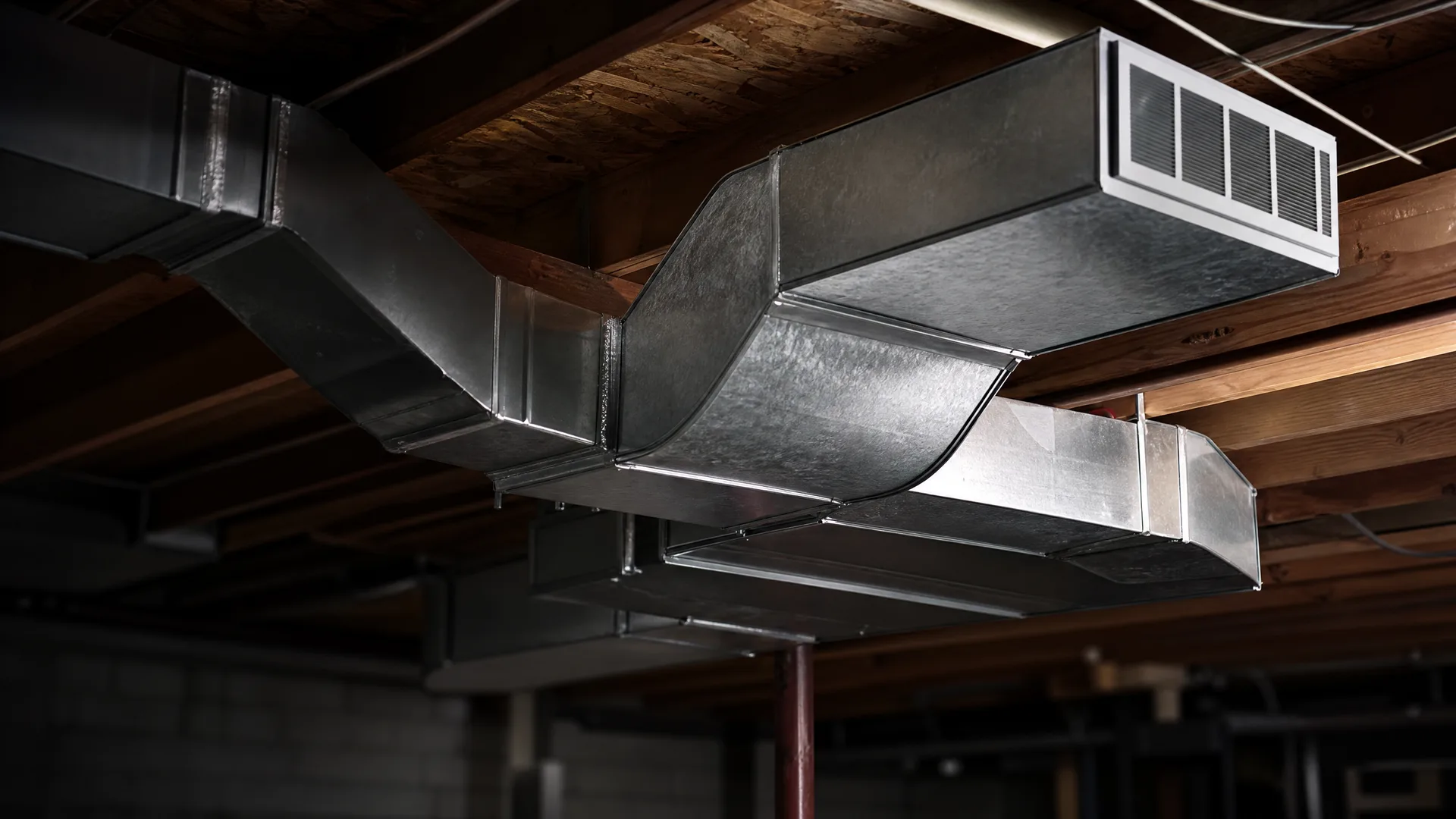
This is what a duct system looks like when it's doing its job. Air moves through the supply runs and back through the returns without picking up anything along the way. No smell when the blower kicks on, no staining around the metal.

Mold can take hold in runs like these, tucked between the joists where nobody looks. Dust settles on the sheet metal, moisture collects where a seam sweats or a drain runs slow, and the mold spreads along the duct from there.


A licensed pro who works in Fairfax County gets your request.
You're not committing to anything by asking.
The smell is usually the first thing. It comes and goes with the blower, strongest right when the system kicks on and fading after a few minutes. Some households notice it more in a bedroom or home office, wherever a vent sits closest to where people are sitting still. Dust seems to settle faster on shelves and furniture than it used to. Anyone in the house with allergies or asthma may notice symptoms get worse indoors than outdoors, especially overnight with the system running and windows shut.
Mold in the ducts doesn't stay put. Every time the blower runs, it carries spores into whatever room that duct feeds, which is every room the system serves. Left alone, it spreads from a damp section near the coil to runs further down the line, and the smell gets harder to pin to one spot. It also means the system is pushing air through a dirtier path than it was built for, so registers and the drain pan nearby are more likely to show staining over time.


Walk past a vent right after the AC kicks on. If the musty smell is stronger there than anywhere else in the room, it's coming from the duct, not the carpet or a closet. Check the grille itself too. A faint gray or black speckling around the slats, or on the wall just above a return, points to the same thing. Some households notice sneezing or a stuffy nose that clears up when they leave the house, which is worth paying attention to. Left alone, the mold doesn't stay put. It keeps feeding on the dust moving through the system, and everyone breathing that air is breathing it too.



It's late April, a Saturday morning, and the light coming through the living room window is the flat gray of a day that can't decide on rain. You're on the floor sorting through a box of old photos when you notice it: a soft gray haze along the ceiling vent grille, the kind of dust that doesn't wipe off with a glance. You look closer and see the same fine film settled on the bookshelf below it, on the lamp shade, on the arm of the couch you vacuumed last weekend. The air conditioning hasn't run yet this year. You get up, pull a chair over, and run a finger along the grille slats. It comes away gray.

Mold in your ducts isn't a mystery once someone opens up the system and looks. It settles where moisture collects, feeds on the dust already sitting in the runs, and spreads from the coil outward every time the blower kicks on. A camera at the plenum and a look at the drain pan usually tells a contractor what's growing and where.
Finding that contractor is its own chore when you're starting from nothing: searching, calling a few companies, describing the smell and where it's worst to each one, then sitting with quotes that don't quite match up. One request here puts you in touch with a contractor local to Fairfax County who works on duct systems through every humid summer the area gets, and you're not fielding calls from three other companies while you decide.

Describe it once