Ductwork doing its job
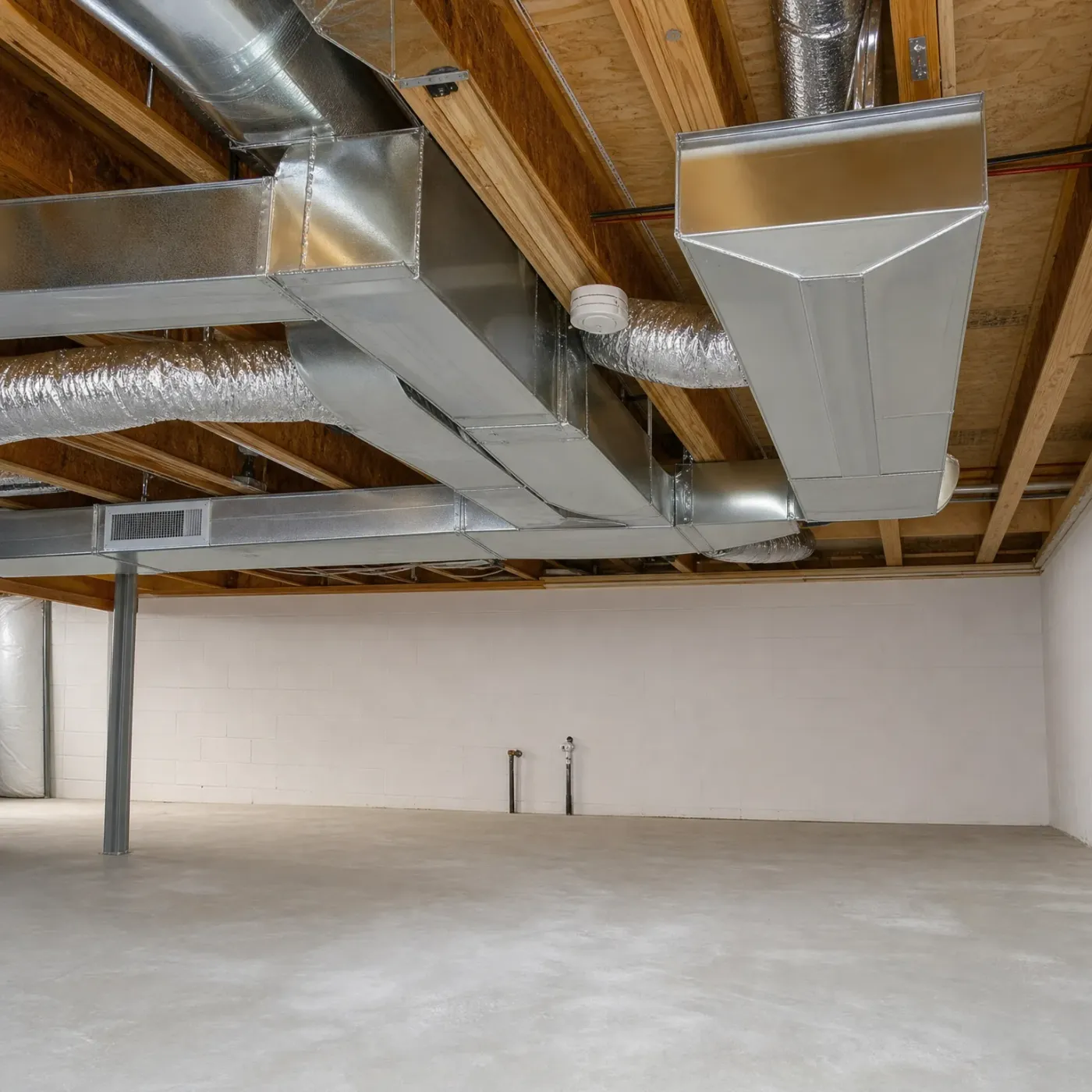
This is what a duct system should look like. Metal trunk lines and flex runs sit open to the air, joists and pipes visible, nothing trapping moisture against the wood. Air moves through clean metal with nowhere damp to sit.
You walk past a vent and catch a damp, musty smell, the kind that reminds you of a basement after rain. Maybe it fades after the AC has run a while, or maybe it lingers no matter what. Either way it makes you wonder what's sitting inside your ducts, and whether it's something you can ignore or something that's going to get worse the longer it stays.
Your air conditioner pulls moisture out of the air as it cools your home, and that water has to drain away through a condensate line. When that line is slow or partly clogged, or when the coil stays wet longer than it should, the damp air sits inside the ducts instead of draining out. Dust and debris in that moisture turn musty fast. Summers here get sticky enough that your system runs long hours pulling humidity out of the air, which gives mold and mildew more chances to take hold inside the ductwork. If the smell shows up mostly when the AC kicks on, that's where it's coming from. A duct system holding onto that moisture for a season or more is worth having looked at before it spreads further.

You're dusting the living room on a mild spring afternoon, windows cracked for the first time since winter, and you notice it: a gray film sitting across the top of the ceiling vent grille, thick enough that you could write your name in it. It's settled on the lamp shade below, too, and along the edge of the bookshelf. You run a finger along the grille slats and it comes away dark. The furnace has been quiet for weeks now, and the AC hasn't kicked on yet, so the air's just been sitting still in those ducts, and whatever settled in there over the winter has been drifting down into the room every time the blower cycles.
Half the homes here were built by 1995
Half the homes in Prince William County were built in 1995 or earlier, so a lot of ductwork around here has had decades to collect dust and moisture.
Heat runs October through April
Heat runs here from October through April, about seven months. Ducts carrying warm air that long build up dust that feeds a musty smell.
Cooling runs June through September
Cooling runs June through September. That's four months of ducts handling cold, damp air, prime conditions for the mold smell to set in.
ACS 2020-2024 · NOAA nClimDiv 1991-2020





This is what a duct system should look like. Metal trunk lines and flex runs sit open to the air, joists and pipes visible, nothing trapping moisture against the wood. Air moves through clean metal with nowhere damp to sit.

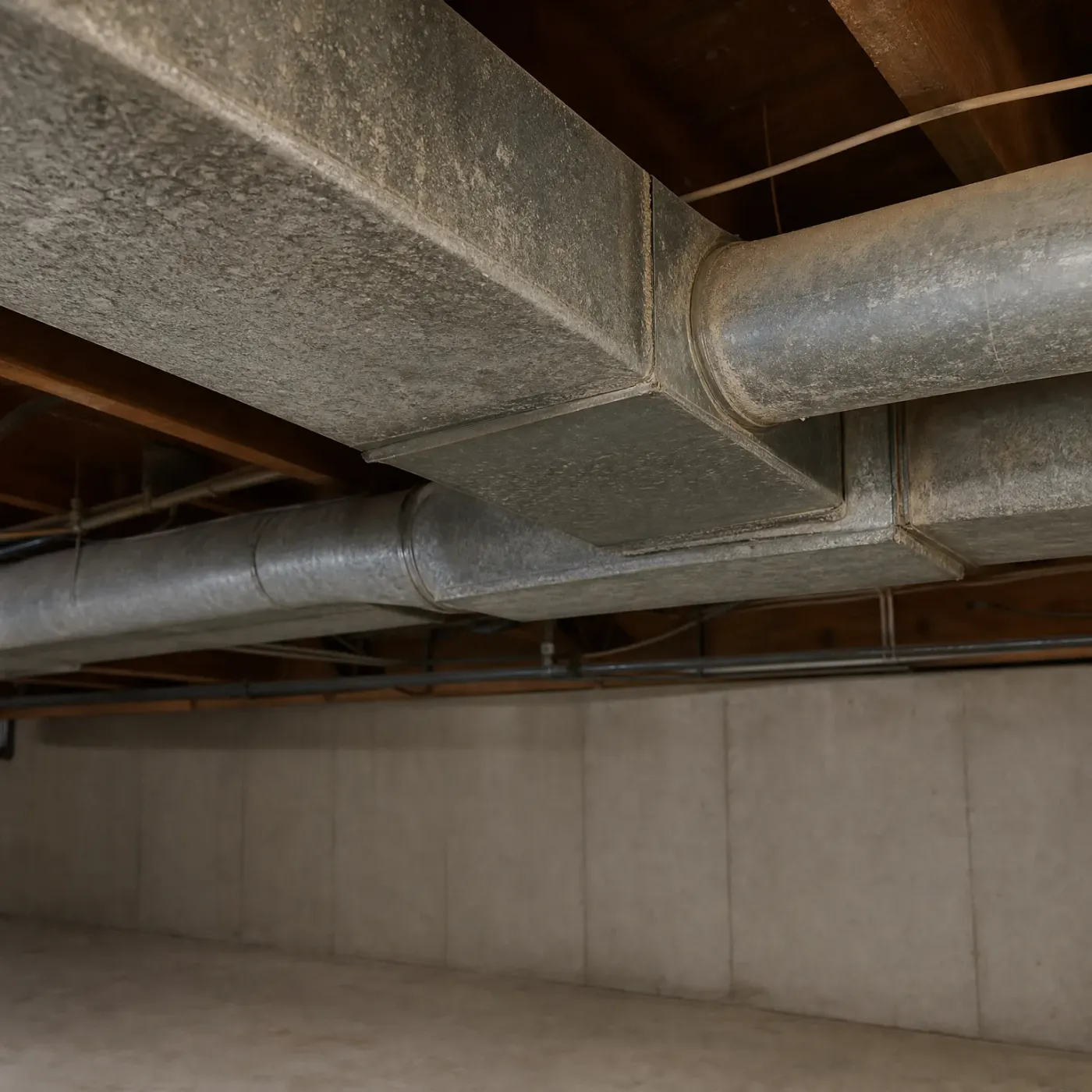
Here the joists above the ducts have gone dark, and the duct surfaces show the same staining. Moisture has been sitting against the wood and metal long enough to leave a mark, and that's often where a musty smell starts.
You might notice it strongest in a bedroom that stays closed most of the day, or near a return vent where the system pulls air back in. Sometimes it rides along with a slight haze on nearby surfaces, a fine film on a windowsill or a lampshade that wasn't there last month. If anyone in the house has allergies or asthma, you may have noticed more sneezing or a stuffy feeling that clears up once they leave the house. Left alone, moisture sitting in the ductwork gives mold a place to keep growing, and every cycle of the furnace or AC pushes that air through every room the ducts reach.


AC runs here from April through October. Every one of those months, condensation forms on the coil and drains away, or it doesn't, and that's when the smell starts.
Dust on an evaporator coil slows the water draining off it, so instead of running down the drain pan, moisture sits against metal and dust long enough to go musty.
Explain the job once and skip repeating it on every call.
No charge to send it. You decide if you hire them.
Mold doesn't start from nothing. It needs dust sitting in the ductwork, warmth, and water it usually gets from a coil or drain line that isn't doing its job. The coil in your AC pulls moisture out of the air all summer, and that water is supposed to drain away through a condensate line to the outside. When that line clogs, water backs up into the drain pan and sits there instead, right next to the duct. Given enough time, that's one of the most common starting points for the smell. Flex duct has insulation wrapped around it, and where a seam in that wrap has come loose, moisture can get in and sit against the duct itself. That damp patch is usually where growth takes hold first, long before it spreads anywhere else. Once it's established, whether in a drain pan, on flex insulation, or inside a metal trunk line, the blower spreads it every time it kicks on. That's why the smell doesn't stay in one room. It shows up at vents across the whole house at the same time, because the air carrying it comes from one shared system. A return vent pulling air from a damp crawlspace or attic can carry that smell in before it ever reaches the coil. And running the AC harder doesn't help once mold has taken hold. It just pushes more air, and more of that smell, through every vent in the house.
At 13.91 cents a kilowatt-hour, running your blower longer to push air through clogged or musty ductwork adds up on your bill. A system working harder to move air through dirty ducts pulls more power every time it cycles on.
EIA-861 2025
A technician inspects every supply and return run with a camera.
A vacuum collector attaches to the main trunk line to hold suction.
Agitation tools knock dust and mold loose from duct walls.
Loosened debris is pulled into the collector and hauled away.

A musty smell from your vents isn't just an odor problem. It's a sign that mold or mildew has a foothold somewhere in your ductwork, and every time the system runs, it pushes that air into the rooms you sleep and eat in. If anyone in your house has allergies or asthma, a closed-up bedroom with a stale smell is the kind of room where that shows up first. The smell doesn't fix itself. It sits there through another humid Virginia summer and another heating season, getting a little more set in.
You don't have to figure out on your own whether this is a coil problem, a drain line problem, or just old dust finally caught up with you. That's the kind of thing that takes someone crawling into your attic or crawlspace with a camera, not a guess from the kitchen table. When you ask for help through this page, you get matched with a contractor who handles duct systems like yours in Dumfries, and they'll reach out to you directly. No calling around to five companies and explaining the same musty smell five times.

You keep the bedroom doors open so air doesn't sit stale in one room. You run the bathroom fan longer than you need to, hoping it pulls some of that dampness out with it. Maybe you've started closing a vent or two, or you light a candle before anyone comes over. None of it touches where the smell starts. It comes back by evening, or by the next time the AC kicks on, because the mold or moisture sitting in the ductwork is still there.

You could search for duct cleaning companies, call three or four, and describe the same smell each time. One asks how old your system is. Another wants photos of the vent grille. You compare quotes that aren't quite for the same scope of work, and you still don't know which company actually clears a drain line versus one that just vacuums the trunk line. Getting matched with a contractor who handles this in Prince William County skips that part. You explain it once.
A musty smell from your vents means moisture is sitting somewhere in the duct system and feeding mold instead of draining away. That's the whole answer. The fix is a cleaning that reaches the coil, the drain pan and the duct runs themselves, not a candle or a new filter. What's left is finding someone who can actually do that work right, and that part tends to eat up a Saturday: searching for a duct cleaning company, calling two or three to ask what their process covers, explaining the same smell and the same layout of your house each time, then sitting with quotes that are hard to compare because you don't know if they're even quoting the same job. You don't have to do that part. Once you're matched with a contractor who handles duct cleaning in your area, they'll reach out to you directly, and you can ask them the questions above yourself. The smell has a cause, the cause has a fix, and now you know what to ask for.

Skip searching for a duct system pro and answer a few questions instead.